When President Vladimir Putin opens the Russia-Africa summit in St Petersburg on Thursday, the attendance cast list will be closely scrutinised – in Paris, Washington, London, and at United Nations headquarters in New York.
But Africans will view the event quite differently.
For Western foreign ministries fretting about the Kremlin’s declared ambition to expand its political, military and economic footprint south of the Sahara, the gathering is an indicator of how far Russia’s influence could now extend and where it will meet a friendly welcome.
Unlike the previous Russia-Africa summit in 2019, attended by 43 African leaders, this time only 17 are expected in St Petersburg.
But which of them will take prominent speaking roles in the summit? What deals will be struck with Mr Putin?
European and US policymakers until recently saw China as their main competitor in Africa – but now find themselves observing with deep unease Russia’s assertive return, epitomised by the presence of Wagner mercenaries in Mali, the Central African Republic (CAR), Libya and, briefly, northern Mozambique.
And of course, the invasion of Ukraine has dramatically heightened Western mistrust of Russia’s ambitions around the world.
Yet little suggests that African leaders share this perspective. Most countries on the continent, even those that have regularly voted at the UN to condemn the attack on Ukraine and its impact, do not want to get drawn into taking sides in a new “Cold War” or become pawns in a tussle for global influence and powerplays.
In any case, Russia is just one of several major actors now stepping up efforts to court political and economic influence in Africa – alongside not only China, but also India, Turkey, the Gulf states, South Korea and, of course, Western nations and Japan.
Having sometimes struggled in the past to mobilise international assistance in tackling their development and security challenges, African governments are not spurning these overtures.
And Russia knows this. In the run-up to the summit, its officials promised a new programme of support for the continent.
The summit agenda includes an “economic and humanitarian forum” and African business figures have been invited; the Kremlin promises a raft of agreements on trade, investment, scientific and technical cooperation.
In pursuing this agenda, Russia may be able to build on the academic and research ties developed during the Cold War era, when many Africans studied at Soviet universities.
But that does not mean most participants will approach St Petersburg with an uncritical mindset – even if diplomatic politeness prevents them from speaking frankly.
Last month’s African leaders’ peace mission to Russia and Ukraine was blunt in telling Mr Putin and Volodymyr Zelensky that the war should be ended, for the sake of the rest of the world.
And Moscow will hardly have bolstered goodwill by its decision to abandon the agreement for the safe export of both Ukrainian and Russian grain through Black Sea ports, even if Mr Putin has pledged to make up that shortfall.
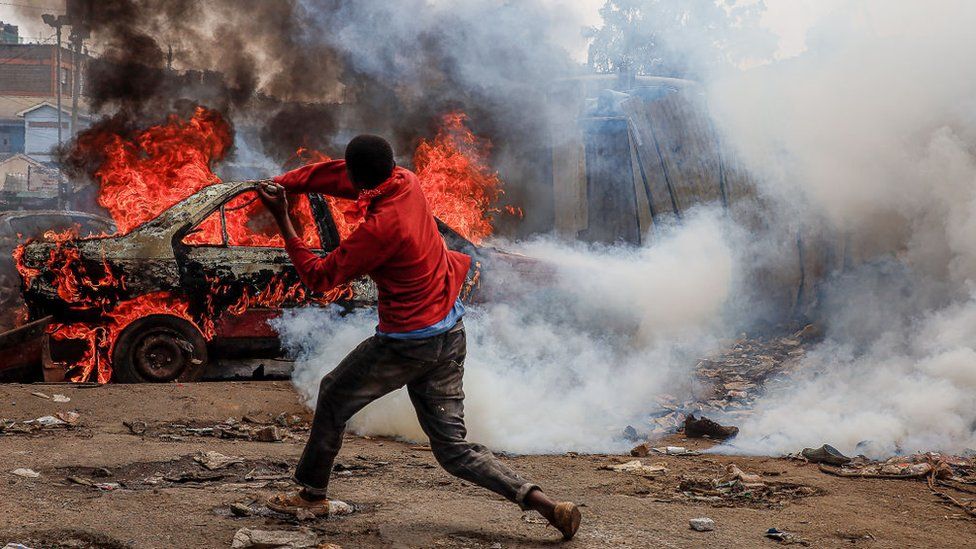
That promises to drive up food prices in numerous African countries, potentially fuelling urban protest and political pressure on the leaders.
Mali – a loyal ally these days, its ruling junta partially reliant on Wagner’s men to keep jihadist forces at bay – claims to be receiving a special shipment of Russian grain.
But it is hard to imagine that Mr Putin could provide such hefty bilateral help to more than a clutch of close allies.
Most African grain consumers will have to continue relying on the open world market – where supplies are now tightening and prices are on the rise.
Mr Putin is well aware of this diplomatic fallout. Could he be waiting for
The cost-of-living crisis has led to riots in countries including Kenya
Mali – a loyal ally these days, its ruling junta partially reliant on Wagner’s men to keep jihadist forces at bay – claims to be receiving a special shipment of Russian grain.
But it is hard to imagine that Mr Putin could provide such hefty bilateral help to more than a clutch of close allies.
Most African grain consumers will have to continue relying on the open world market – where supplies are now tightening and prices are on the rise.
Mr Putin is well aware of this diplomatic fallout. Could he be waiting for the summit to perhaps offer a supposedly magnanimously return to the grain deal, on slightly tweaked terms?
That’s not the only delicate issue on the agenda.
Displaced from Russia after his recent mutiny, Wagner boss Yevgeny Prigozhin recently promised his men an expanded focus on African operations.
Despite his apparent falling out with Mr Putin, this would certainly help the Kremlin’s drive to extend its capacity to influence African events, particularly in the hugely fragile Sahel region – where Niger’s democratically elected President Mohamed Bazoum has been detained by soldiers in a coup bid that could have a major regional impact if it ultimately succeeds.
When Wagner moved into the CAR after President Faustin Archange Touadéra sought Russian help to overcome a UN arms embargo and rebuild his army in 2017-18, this at first looked like a bid for attention, aimed to send the message that “Moscow is back” after more than two decades of a low profile after the collapse of the Soviet Union.
But by the time Wagner arrived in Mali in 2021, at the invitation of the soldiers who had seized power the year before, the role played by this private military contractor in Russia’s security agenda, was viewed with a good deal more mistrust.
Most other West African governments saw it as a direct threat to the security of their region. Their relations with Mali soured dramatically.
And the coups that followed in Guinea and Burkina Faso, with pro-Russian youths cheering in the streets of the latter’s capital Ouagadougou, have only deepened elected African governments’ wariness of Moscow’s strategy.
But that does not mean they will disregard this week’s summit.
Instead, they will probably try to nudge the Kremlin towards a more conventional path of cooperative engagement, and away from support for the destabilisation of constitutional government and towards more conventional military partnerships through training and the supply of equipment and weapons.
And Russia will try to secure their goodwill through a continuation of its economic diplomacy.
GETTY IMAGESImage caption,
The cost-of-living crisis has led to riots in countries including Kenya
Mali – a loyal ally these days, its ruling junta partially reliant on Wagner’s men to keep jihadist forces at bay – claims to be receiving a special shipment of Russian grain.
But it is hard to imagine that Mr Putin could provide such hefty bilateral help to more than a clutch of close allies.
Most African grain consumers will have to continue relying on the open world market – where supplies are now tightening and prices are on the rise.
Mr Putin is well aware of this diplomatic fallout. Could he be waiting for the summit to perhaps offer a supposedly magnanimously return to the grain deal, on slightly tweaked terms?
That’s not the only delicate issue on the agenda.
Displaced from Russia after his recent mutiny, Wagner boss Yevgeny Prigozhin recently promised his men an expanded focus on African operations.
Despite his apparent falling out with Mr Putin, this would certainly help the Kremlin’s drive to extend its capacity to influence African events, particularly in the hugely fragile Sahel region – where Niger’s democratically elected President Mohamed Bazoum has been detained by soldiers in a coup bid that could have a major regional impact if it ultimately succeeds.
When Wagner moved into the CAR after President Faustin Archange Touadéra sought Russian help to overcome a UN arms embargo and rebuild his army in 2017-18, this at first looked like a bid for attention, aimed to send the message that “Moscow is back” after more than two decades of a low profile after the collapse of the Soviet Union.
But by the time Wagner arrived in Mali in 2021, at the invitation of the soldiers who had seized power the year before, the role played by this private military contractor in Russia’s security agenda, was viewed with a good deal more mistrust.
Most other West African governments saw it as a direct threat to the security of their region. Their relations with Mali soured dramatically.
And the coups that followed in Guinea and Burkina Faso, with pro-Russian youths cheering in the streets of the latter’s capital Ouagadougou, have only deepened elected African governments’ wariness of Moscow’s strategy.
But that does not mean they will disregard this week’s summit.
Instead, they will probably try to nudge the Kremlin towards a more conventional path of cooperative engagement, and away from support for the destabilisation of constitutional government and towards more conventional military partnerships through training and the supply of equipment and weapons.
And Russia will try to secure their goodwill through a continuation of its economic diplomacy.
GETTY IMAGESImage caption,
The cost-of-living crisis has led to riots in countries including Kenya
Mali – a loyal ally these days, its ruling junta partially reliant on Wagner’s men to keep jihadist forces at bay – claims to be receiving a special shipment of Russian grain.
But it is hard to imagine that Mr Putin could provide such hefty bilateral help to more than a clutch of close allies.
Most African grain consumers will have to continue relying on the open world market – where supplies are now tightening and prices are on the rise.
Mr Putin is well aware of this diplomatic fallout. Could he be waiting for the summit to perhaps offer a supposedly magnanimously return to the grain deal, on slightly tweaked terms?
That’s not the only delicate issue on the agenda.
Displaced from Russia after his recent mutiny, Wagner boss Yevgeny Prigozhin recently promised his men an expanded focus on African operations.
Despite his apparent falling out with Mr Putin, this would certainly help the Kremlin’s drive to extend its capacity to influence African events, particularly in the hugely fragile Sahel region – where Niger’s democratically elected President Mohamed Bazoum has been detained by soldiers in a coup bid that could have a major regional impact if it ultimately succeeds.
When Wagner moved into the CAR after President Faustin Archange Touadéra sought Russian help to overcome a UN arms embargo and rebuild his army in 2017-18, this at first looked like a bid for attention, aimed to send the message that “Moscow is back” after more than two decades of a low profile after the collapse of the Soviet Union.
But by the time Wagner arrived in Mali in 2021, at the invitation of the soldiers who had seized power the year before, the role played by this private military contractor in Russia’s security agenda, was viewed with a good deal more mistrust.
Most other West African governments saw it as a direct threat to the security of their region. Their relations with Mali soured dramatically.
And the coups that followed in Guinea and Burkina Faso, with pro-Russian youths cheering in the streets of the latter’s capital Ouagadougou, have only deepened elected African governments’ wariness of Moscow’s strategy.
But that does not mean they will disregard this week’s summit.
Instead, they will probably try to nudge the Kremlin towards a more conventional path of cooperative engagement, and away from support for the destabilisation of constitutional government and towards more conventional military partnerships through training and the supply of equipment and weapons.
And Russia will try to secure their goodwill through a continuation of its economic diplomacy.

 AFRICAN HERALD TRIBUNE
Leave a comment